.






Mitts
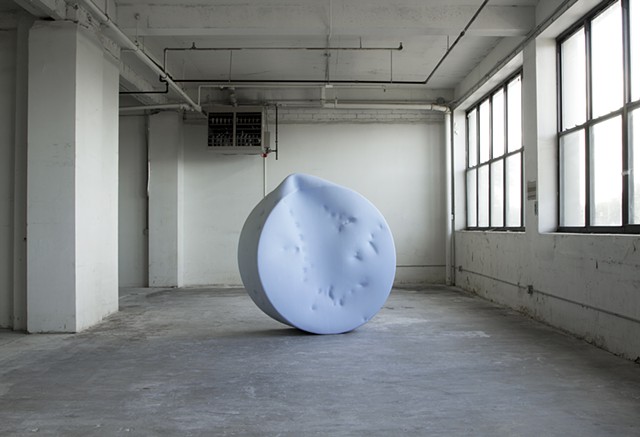
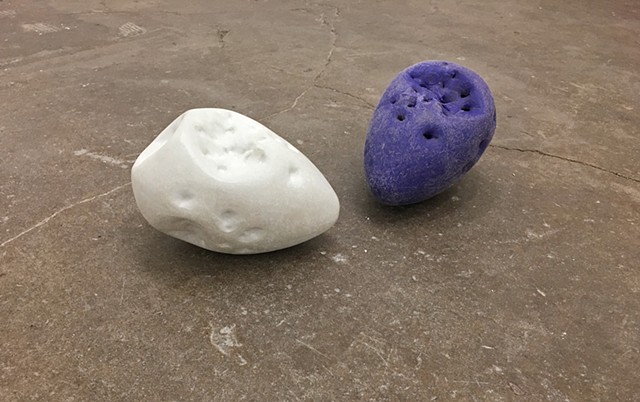
In the summer of 2018 I acquired thirteen "behavioral enrichment" objects shaped by large cats and bears at the St Louis Zoo. I 3-D scanned five of the objects and since then I’ve been materially translating and recontextualizing them. The object pictured to the left, is branded “Pill” by its distributor Wildlife Toybox. It was subsequently shaped by an 1150 pound polar bear named Kali.
Behavioral enrichment is an animal husbandry principal that seeks to buoy the mental health of captive animals. I particularly like the designation “Pill” because it foregrounds the palliative roll these objects are intended to perform. They’re designed to stimulate, distract, placate, entertain; to be therapeutic. There are countless parallels prescribed to people, by themselves or others, from stuffed animals to films to drugs to sports, most things called “leisure” and many things called “culture.” Part of my intention in recontextualizing these objects as sculptures is to probe the similarities between animal enrichment and human enrichment.
The objects I’m interested in starkly contrast the aesthetics of the environments that all mammals evolved in. Like candy and toys for children, they’re brightly colored, idealized forms that don’t reflect anything in the pre-human world. They emerged from virtual space (most feel as though they were plucked from the "tools" menu of a 3D modeling program), into the lives of lions, tigers, bears, otters, primates etc. with the allure of the shiny black monolith at the beginning of 2001: A Space Odyssey.
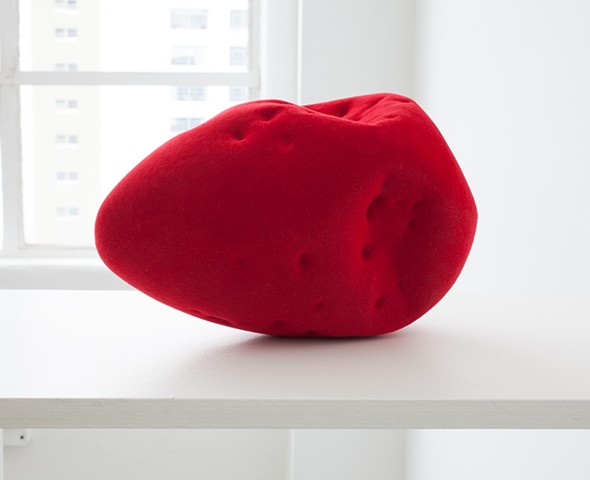
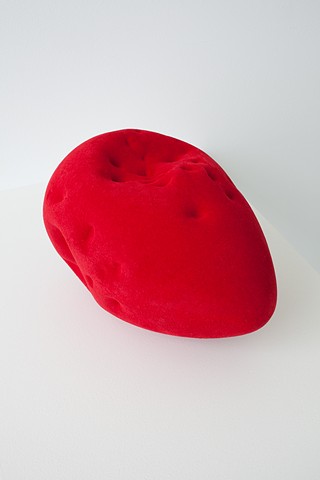
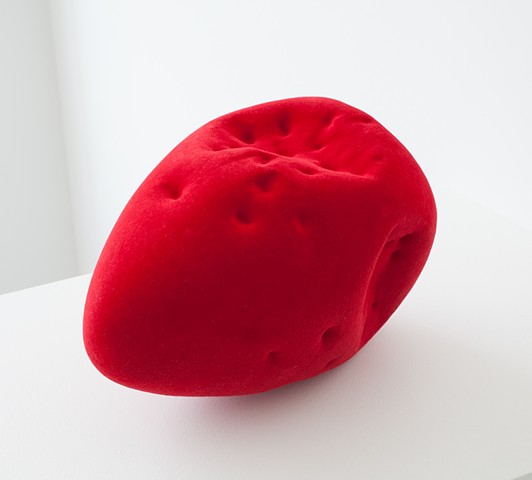
Though many of the animals that live in zoos were raised in captivity and have never known the world beyond their enclosures, there’s an inherited, embodied familiarity with the environments they evolved in. Their physiology and cognition were shaped by environments that differ radically from their enclosures and there’s inevitably, as with people, some friction generated by that difference. Enrichment objects serve to absorb and neutralize that friction and are, in turn, deformed by it. Over months they become diaries of the animals’ moods and somatic urges, their anxiety, their curiosity and playfulness; feedback from their dislocation.
Seeing Pill returned to the virtual realm, Kali’s presence radiates from the image like sound from a record. Seeing her mark-making divorced from the physical world foregrounds her distinctly non-human sensibilities in a domain of abstraction historically guarded as uniquely human. The virtual form obscures that divide and presents Kali’s smoothed-out impressions as thought; as a reflection of her life in St. Louis.
In re-materializing Pill I wanted to monumentalize Kali’s mark-making while retaining the “thought” quality of the scan. It felt important to exclude my hand from the rendering as much as possible so I collaborated with a KUKA robot to carve a six foot translation of the file. The robotic arm, with a mass comparable to Kali’s body, meticulously traced her impressions in a large block of foam. It engendered a species of empathy I feel incapable of writing about and while I regret not taking more video documentation of this performance, I love thinking about the moments when it was taking place unobserved.
I shelled the carving with a polyurea coating and painted it a chalky, pharmaceutical blue. The object is large but weighs less than 40 pounds which helps it float between worlds. I used the found title Pill because it prods so many aspects of this conversation while plainly describing the form. To date I’ve done several other translations of the scans including Sculpture for the Blind, a polished concrete, one to one mirror image of a “Jolly Egg.” The objects are actively rolling around my studio and I’m doing my best to pay attention.